

If you are thinking about suicide or feel you might hurt yourself, seek support now. In the United States, call or text 988 or use the 988 Suicide & Crisis Lifeline. Call 911 for a life-threatening emergency. Outside the U.S., contact your local crisis service or emergency number. You do not have to make yourself feel better before asking for help.
When self-respect feels difficult, a demand to “love yourself” can feel like another task you are failing. Start with how you treat yourself today. Care, support and reasonable limits can be worthwhile even when you do not feel confident or positive.
On this page
Receive support without proving your worth
You do not need to admire yourself, explain every feeling or reach a particular level of distress before talking with someone. Tell a trusted person what is happening and what you need, such as company or help contacting a professional.
The 988 Lifeline’s guide to what to expect when reaching out explains how a counsellor asks about safety, listens and discusses support. You can begin with a simple description of the difficult moment you are in.
If someone is mistreating you, feeling better about yourself is not a condition for deserving respect. Consider what support and protection you need. You do not cause another person’s harmful behaviour by struggling with confidence.
Use fairer words about yourself
Try replacing a whole-person judgement with a specific description. “I missed a deadline and need to discuss it” gives you more to work with than “I’m useless.” Fair language can acknowledge a problem without turning it into your identity.
Include context: what you knew, what resources you had and what was beyond your control. Fairness does not require pretending that every choice worked out well.
If you hurt someone, consider a proportionate apology or correction. You do not need to force forgiveness or maintain self-punishment indefinitely. Responsibility concerns the action and what you can reasonably do next.
A mistake can be information about a plan, skill or unmet need. Ask what would make the next attempt more workable rather than demanding that you never fail again.
Keep room for your own preferences
You can consider other people’s advice while retaining your own choices. Start with something ordinary: which invitation to accept, how to spend a quiet hour or what you are comfortable sharing.
An intuitive feeling may be worth reflecting on alongside evidence and practical considerations. You do not have to treat every impression as an instruction or prove confidence by ignoring useful advice.
Skills and achievements can matter to you without becoming the measure of whether you deserve care. You remain entitled to kindness on days when you cannot do much.
Caring about others can include limits. You may decline a request, ask for a fair share of work or leave a hurtful conversation. Kindness does not require unlimited availability.

Choose one manageable act of care
Choose something that fits your current capacity: eating a meal, attending an appointment, asking for help with a task or making time to rest. The action does not need to change your mood immediately.
An enjoyable activity can be an option rather than a prescription. You might listen to familiar music, spend time with a pet or contact a friend. It is okay if pleasure is difficult to access right now.
Gratitude is optional. You can appreciate something and still feel disappointed or distressed. There is no need to thank someone for hurting you to demonstrate growth.
New experiences can wait until you want them. A small, familiar activity may suit you better than taking on a challenge to prove that you are changing.
If writing helps, note one need and one possible response. If it becomes another way to criticise yourself, stop or choose a conversation instead.
Review what helps and ask for more support
You do not have to revisit every painful memory to understand your present needs. Choose what to discuss and at what pace, with appropriate support if the material is overwhelming.
Humour and light moments can have a place when they are welcome. You do not need to laugh at yourself, appear cheerful or minimise something that hurts.
Notice whether the support you have is enough. If distress persists or makes daily life difficult, speak with a qualified health professional. If safety is a concern, return to immediate crisis support rather than waiting for a self-care exercise to work.
Read the infographic in text
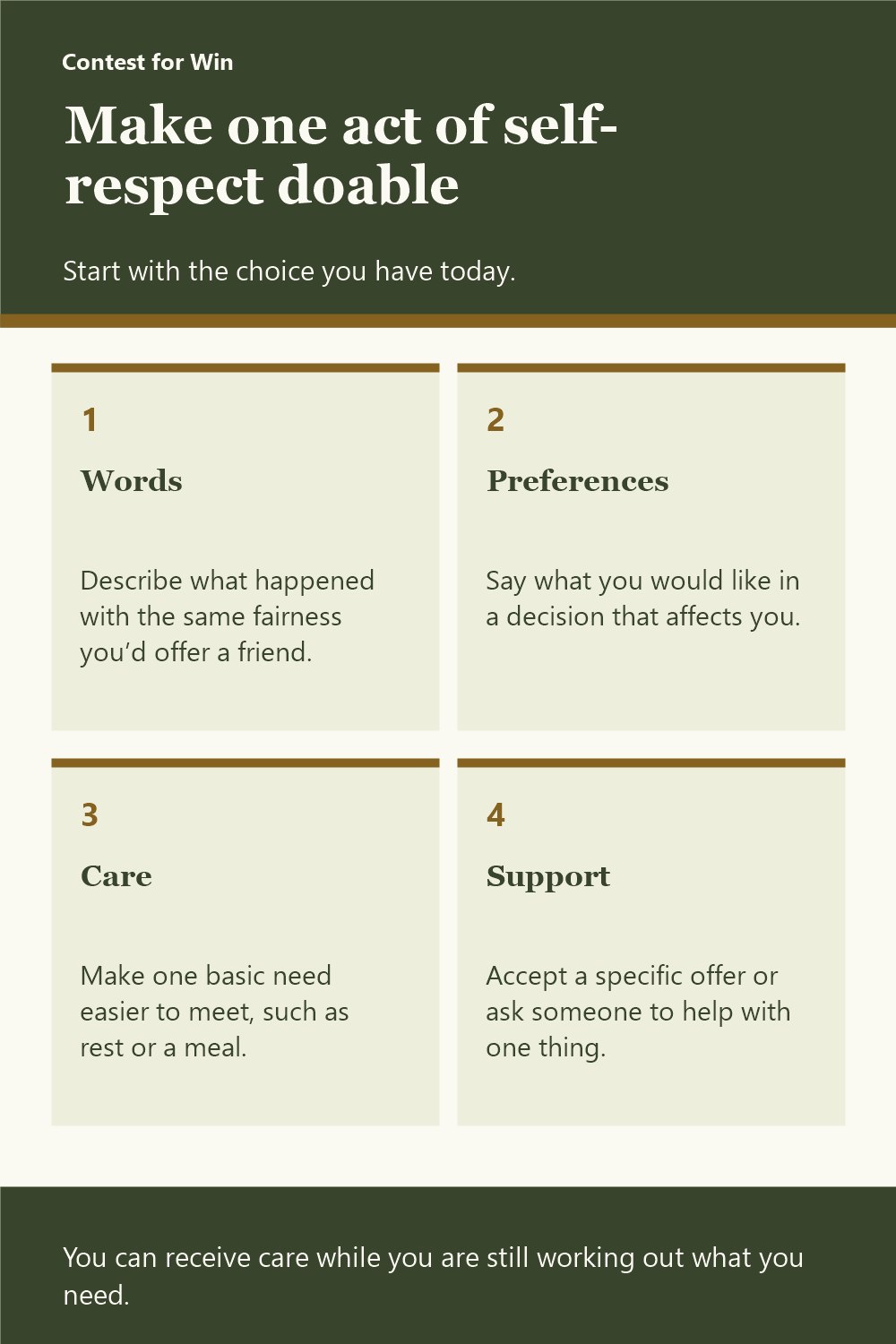
Make one act of self-respect doable Start with the choice you have today.
- Words Describe what happened with the same fairness you’d offer a friend.
- Preferences Say what you would like in a decision that affects you.
- Care Make one basic need easier to meet, such as rest or a meal.
- Support Accept a specific offer or ask someone to help with one thing.
You can receive care while you are still working out what you need.